Our Software
PLE - The Software
For modelling and analyzing pipelines we make use of the PLE pipeline analysis program. The development team of this program is also part of r+k Consulting Engineers. In this way, knowledge and skills from the branch as a whole is used to solve complex pipe-soil problems and to further develop the PLE program and the ways in which this program can be used.
The Software Key Numbers
- Different Modules for Various Aspects of Pipeline Analysis
- 31
- Time Saved results in Reduced Design Time
- >30%
- Projects supported by this Software
- 1000+
- Experience with the Software PLE
- 60+ years
- Independant Consultancy
- 100%
- Pipes and Pipeline Assessed
- >10,000 km's
- Environments (Soft Soils, Offshore, Land Falls, Earth Quake Hazards)
- All
- Is Your Project Next?
- ...
Additional External Loads on an Existing Pipeline
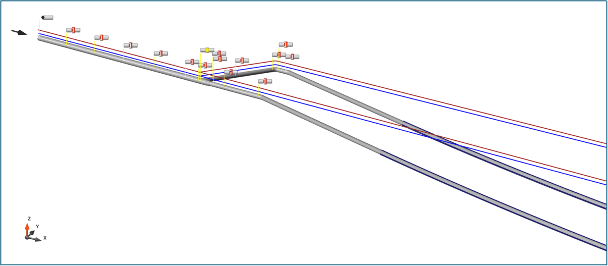
Over an existing gas pipeline, a temporary road will be constructed. As a result, the soil cover on this pipeline will increase and settlements of the subsoil is expected. The owner of the gas pipeline wants to be sure that this pipeline will be able to withstand these extra loads and stays fit for purpose.
A model of the pipeline, the soil and the pipeline loading was made. Key features of this project are:
- Pipe dimensions (D x t): 203.2 mm x 5.56 mm and 203.2 mm x 6.3 mm.
- Pipe material: L240 NB/MB steel.
- Important loads: internal pressure: 40 barg, temperature range: from -20°C up to 50°C, soil settlement: 70 mm.
- Analyses show the pipeline will stay within acceptable limits according to Dutch Pipeline regulations (NEN 3650).
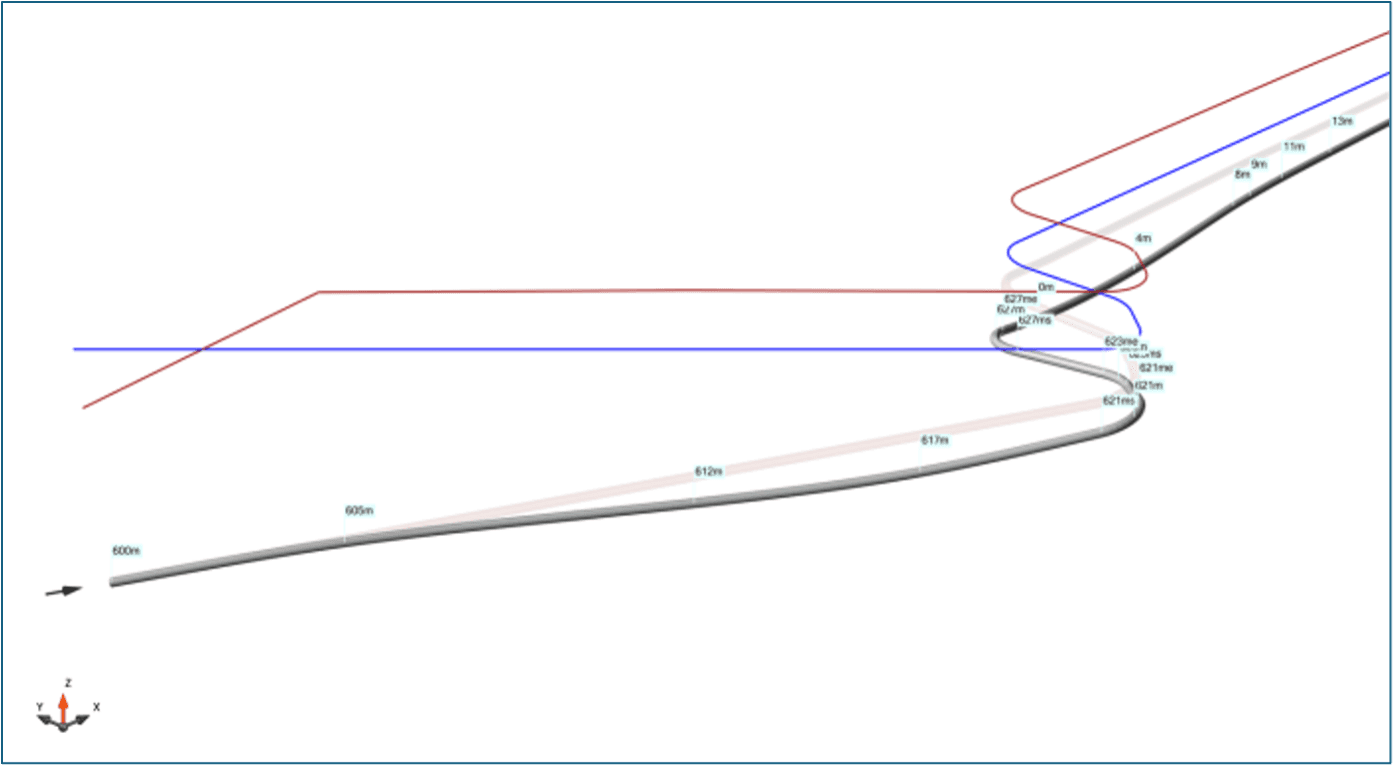
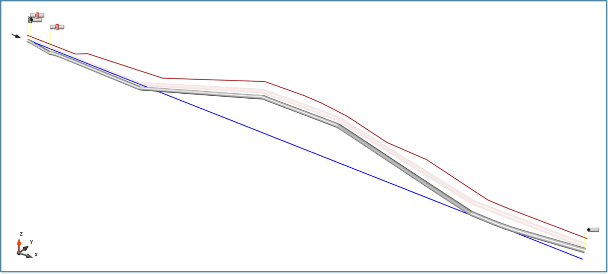
Temporary road over an existing pipeline (at the S-shaped part).
Ground and water level are shown in red and blue, the original and displaced pipeline are shown translucent and gray.
Optimization of an Existing Pipeline System
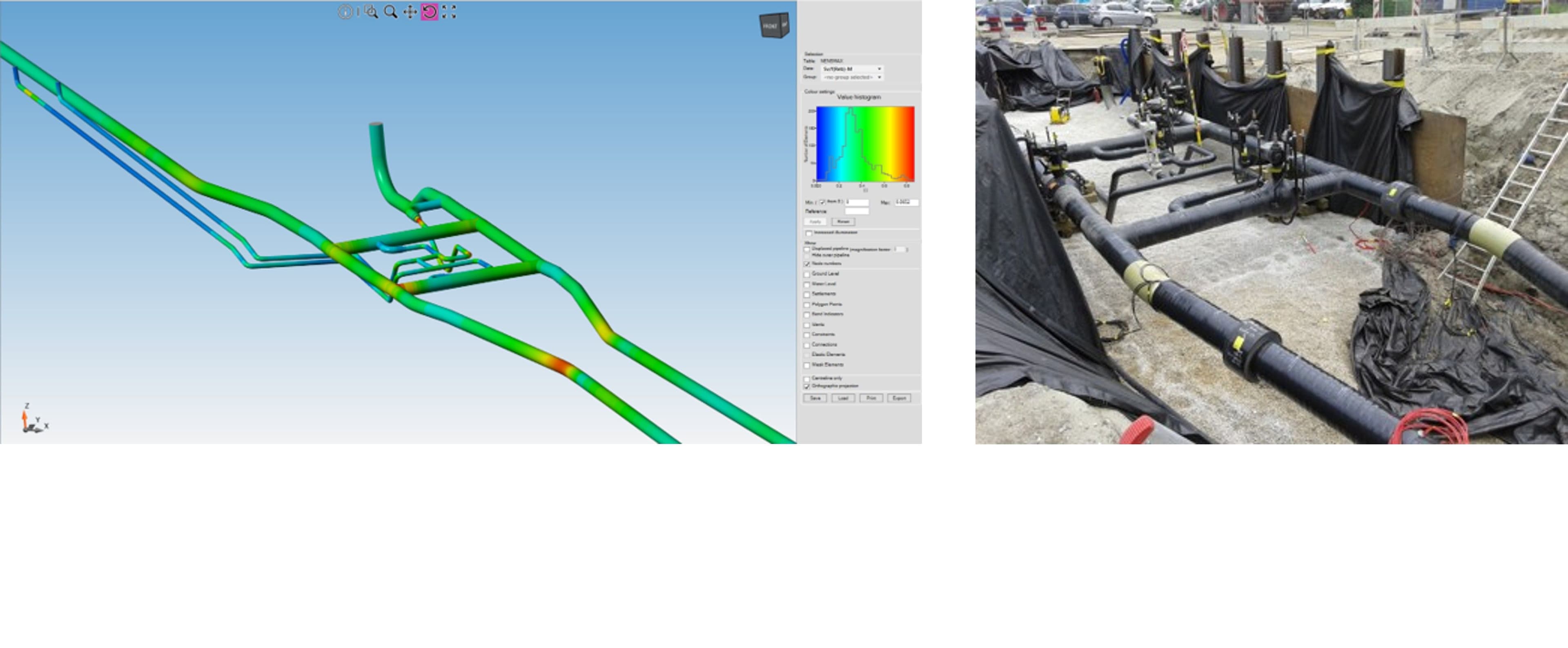
An existing pipeline installation will be upgraded and several pipelines will be replaced with new ones. In one of the sections, a pipeline connecting different parts of the installation is redesigned and the new design has to be checked to see if it is in accordance with the ASME B31.3. The pipeline is mostly underground and placed on supports, while the soil will settle around 10 mm every year.
Key features of this project are:
- Pipe dimensions (D x t): 762 mm x 22 mm, 609.6 mm x 24.6 mm and 508 mm x 20.6 mm.
- Pipe material: A671CC70 steel and A333Gr.6 steel.
- Important loads: internal pressure: 80 barg, temperature range: from -46°C up to 50°C, soil settlement: 300 mm.
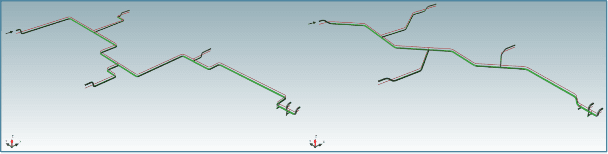
After modelling and calculating, the original (re)design (as shown on the left below) was proven to be an acceptable solution.
The second part of this assignment was to make an alternative design, in which less material was used, while still being in accordance with ASME B31.3. The result can be seen in the picture on the right. Differences between redesign and alternative design: 11% reduction in pipeline length, less bends (from 24 down to 21) and smaller bend angles (45° instead of 90°) and less supports (from 31 down to 26). The alternative design reduces costs significantly.
Horizontal Directional Drilling (HDD) with Cast Iron Pipe Segments
A potable-water pipeline has to cross a waterway. This is done by using horizontal directional drilling (HDD) of a nodular cast iron pipeline, using 59 pipes, each with a length of 6 meter and connected with tensile resistant socket-spigot connections.
Key features of this project are:
- Method of installation: HDD with a length of 350 meter and maximum depth of 15.6 meter.
- Pipe dimensions (D x t): 945 mm x 12.6 mm.
- Pipe material: nodular cast iron.
- Important loads: internal pressure: 6 barg, soil pressure, pulling forces.
A pipeline / soil model was made and calculations were done to see if the pipeline design is according to the Dutch NEN 3650 code. Another calculation was done to check if the pulling force wouldn’t exceed the maximum allowable force.
The results showed that the design criteria were met.
Dike Crossing with Material Selection for Pipeline
A raw-water pipeline has to cross a dike near Dordrecht, The Netherlands. This pipeline has a design service life of 50 years and during this time the soil will settle. The pipeline will undergo deformations and has to withstand these without losing its integrity. The first pipeline design consisted of a steel pipeline. Although this pipeline was strong and flexible enough, it was unclear if corrosion could be mastered. An alternative design, made of polyethylene, was proposed. Calculations on the pipeline model showed that a pipeline made from this material would be a good choice.
Key features of this project are:
- Pipe dimensions (D x t): 609.6 mm x 12 mm and 630 mm x 57.2 mm
- Pipe material: S235 steel and PE100 polyethylene.
- Important loads: internal pressure: -0.8 and +0.8 barg, soil settlement and soil subsidence: 290 mm.
Multiple Materials and Mixed Installation Method
To cross an existing highway, two parallel horizontal directional drillings (HDD’s) will be made, using polyethylene pipes. Beside the highway, these pipes will be connected to a nodular cast iron pipe. The two separate pipelines will join, using a Y-joint.
Key features of this project are:
- Method of installation: Partially conventional trench, plus two separately drilled HDD’s with a length of 235 meter and maximum depth of 23 meter.
- Pipe dimensions (D x t): 842 mm x 11.7 mm, 1048 mm x 13.5 mm and 800 mm x 72.7 mm
- Pipe material: nodular cast iron and PE100 polyethylene.
- Important loads: internal pressure: 5 barg, soil subsidence: 58 mm, soil pressure, pulling forces and traffic loads.
Analyses were done to ensure all parts of the pipeline were meeting the Dutch pipeline code NEN 3650-2:2012 requirements.